


Konya Moving Full Balkan Tour (Belgrade- Skopje)
Tour Detail
KONYA – BELGRADE
Departure from Konya on AJET HY’s charter flight, flight to and arrival in Belgrade. Accompanied by our vehicle and guide waiting for us at the airport, we begin our Belgrade city tour. During this tour, after visiting New Belgrade, Josip Broz Tito’s Mausoleum in Dedinje, the New Palace of Justice, the Federal Parliament, Terazije Street, the National Theatre, Belgrade Fortress, one of the Ottoman navy’s supply centers, Fortress Square, Stone Square, the Tomb of Şehit Ali Pasha, Bayraklı Mosque, and the Church of the Virgin Mary of the Rose, we will see the Sava Cathedral, the General Staff building bombed by NATO in Belgrade in 1999 due to the Kosovo events, the police headquarters building, and the Chinese Embassy. After free time, we have dinner and stay overnight at our hotel.
BELGRADE – SARAJEVO
After breakfast at the hotel, we set off toward Sarajevo, the capital of Bosnia and Herzegovina. Upon arrival in Sarajevo, we head to Baščaršija. Along our route, we will see buildings that still bear the traces of wartime bombardment, Europe’s first electric tram line, which still operates across Sarajevo, buildings belonging to the Yugoslav People’s Army from the Tito era that are now used as the Sarajevo university campus, the United States’ second-largest embassy building in the world, the Sarajevo City Museum, the Parliament building, and the region’s largest shopping mall built by Arab investors, before arriving at Baščaršija. Our first stop is the memorial cemetery where the martyrs of the tragic war of 1992–1995 and Alija Izetbegović’s memorial grave are located. We recite Fatiha for the war martyrs and receive information from our guide about Bosnia and Herzegovina’s first President, Alija Izetbegović, and his life. Then, passing through the Ottoman-era cobblestone Bosniak-Turkish quarter that has survived to this day, we begin our walking tour of Baščaršija. Among the places we will see during the tour are: Sebilj, built in 18th-century Bosnian architecture; the only active art street surviving from the Ottoman period, “Coppersmiths’ Street”; the Bazaar Mosque; Morića Han and the “Mladi Muslimani” organization clubhouse inside it; Gazi Husrev-bey Mosque and tomb, located in the quarter of Kanuni Sultan Süleyman’s cousin; the Clock Tower; the Kurşunlu Madrasa; Gazi Husrev-bey Museum and Library; Europe’s first public toilet; the Latin Bridge, known as the place where World War I began; the Hünkar Mosque built in the name of Fatih Sultan Mehmet; At Meydanı – Okmeydanı; Bakır Baba Mosque built by Bursa Metropolitan Municipality; the Orthodox Church; Alija Izetbegović Park and Sarajevo’s retirees who constantly play chess in the park; Ferhadija Mosque; Ferhadija Street (Sarajevo’s Istiklal Street); the Jewish Synagogue; the Catholic Church – Cathedral – Church of the Sacred Heart of Jesus; Sarajevo Roses (places where more than one person lost their life due to a bomb during the war); the site of the Bread Factory massacre; the eternal flame lit on April 6, 1945 in memory of the liberation of Sarajevo, occupied by the Germans, by the Yugoslav army; Markale Neighborhood Market, where 68 people lost their lives in the market massacre on February 5, 1994; and Vjeçnica (Vijećnitsa) Library, built as the Government Building (City Hall) during the Austro-Hungarian period and burned during the war, causing many manuscripts to turn to ashes. After our walking tour in Baščaršija, we have dinner at our local restaurant and go to our hotel to stay overnight.
SARAJEVO – KONJIC – JABLANICA – BLAGAJ - MOSTAR
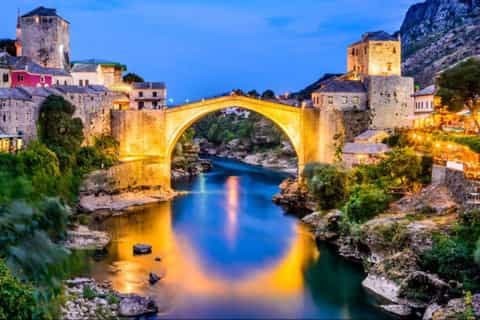
After an early breakfast at our hotel, we depart from the hotel and begin our Mostar tour. We arrive in the city of Konjic, our first stop (Sarajevo – Konjic – 50 km). In this small city of 50,000 people, built on the banks of the Neretva River, we will see the Ottoman bridge damaged in World War II and the 1992–95 war and restored by the Turkish General Directorate of Highways and TIKA, the mosque with the broken minaret, and the mini bazaar restored in accordance with the original. After our photo break, we continue our journey. Our next stop is Jablanica, the city where the battle took place in which Josip Broz Tito, founder of Yugoslavia, received the title of marshal. (Konjic, Jablanica – Konjic 23 km) In this city, famous for its roast lamb, we see the bridge destroyed by Tito’s struggle against the Nazi Germans in 1943 and the area where the event took place. Then we head to the Alperenler Lodge, established 5 centuries ago at the source of the Buna River. (Jablanica, Blagaj – Jablanica 59 km) On the way, we see Mostar Airport and the military area built opposite the airport during the Yugoslav era and used as a shelter for aircraft. This area was excavated into the hill directly opposite the airport and prepared for hiding planes. We visit the lodge, also known as the Yellow Saltuk Lodge, built at the source of the Buna River, whose source has still not been fully reached and from which up to 43,000 liters of water per second emerge. We visit the tombs of Ali Pasha and Sarı Saltuk located inside the lodge, and in this two-story house built in the style of a typical Anatolian house we see the women’s prayer room, the hall room, the men’s prayer room and dhikr room, the bathhouse and seclusion room, and the room used as a kitchen. Our guests who wish may drink Turkish tea in the courtyard overlooking the river. Our final stop today is the city of Mostar. (Blagaj–Mostar 12 km) The places to be seen during our tour are: the Martyrs’ Mosque and the cemetery in its courtyard. One special feature of this cemetery is that Croat and Serb Mostar residents who fought shoulder to shoulder with Muslim Bosniaks during the war are also buried there. The cobblestone Mostar bazaar paved with stones collected from the region’s special river, the Koski Mehmet Pasha Mosque. This mosque is the one from which the best photo of the bridge is taken. The Consulate General of the Republic of Turkey in Mostar, Mostar Bridge – a single-arch bridge built in 1566 by Mimar Sinan’s student Mimar Hayrettin, destroyed in 1993 and restored again in 2004. Tara Tower – these towers were once reserved for teams ensuring bridge security, but today they serve as a museum. Kriva Cuprija – the Crooked Bridge, the Tabačhana mosque and bathhouse – a mosque specially built by the notables engaged in leatherwork so as not to disturb the congregation in other mosques with their smell, and with water flowing beneath it. After dinner at our local restaurant, overnight stay at our hotel in Mostar.
MOSTAR – KOTOR – ST. STEFAN – PODGORICA (or accommodation in Shkodra)
After an early breakfast at our hotel, we head to Montenegro. We leave Bosnia and Herzegovina by passing through the towns of Stolac, Ljubinje, and Trebinje. After crossing the Montenegro border, we arrive in Kotor, a medieval city protected by UNESCO. On the city tour we will do with our local guide in Kotor, the places to be seen are: the Weapons Square, the Clock Tower, the Column of Shame, the Cathedral of Saint Tryphon, the Street of Craftsmen, the Tulumba Fountains, the River Gate, and Saint Lula Square. After our walking tour, we arrive at St. Stefan Island. After the photo break we will give here to immortalize the magnificent view, we arrive in the capital of Montenegro, Podgorica, after a short journey. We have dinner at our local restaurant in the capital Podgorica and then go to our hotel. (If accommodation is in Shkodra, there will be no stop in Podgorica)
PODGORICA (or Shkodra) – TIRANA – ELBASAN – STRUGA – OHRID
After breakfast, panoramic city tour by our bus in the capital Podgorica. During our tour, the Presidential Palace, the city park built by Azerbaijan, the Millennium Bridge, and the King Nikola Statue will be seen. Then we cross the border gate and enter Albania. Our first stop is the city of Shkodra, established next to Lake Shkodra, which forms the border between Albania and Montenegro. (Podgorica– Shkodra 55 km) In this city, which remained under Ottoman rule for 435 years and is strategically one of the most important cities in the Balkans, we will see the city fortress and walls. We will take a short walking tour during our break in the city center. After free time in the center, we continue to the capital Tirana. (Shkodra - Tirana 115 km) In Tirana, renovated by Suleyman Pasha in 1614 and the capital of Albania since 1920, the places we will see on our panoramic tour by bus are: the Embassy of the Republic of Turkey, the US Embassy, the construction of the four-balcony Namazgah Mosque financed by the Diyanet Foundation, the statue of Suleyman Pasha, founder of Tirana, Tirana city square, Ethem Bey Mosque, Clock Tower, National Museum, University Building, Opera and Ballet Building, the statue of Skanderbeg, the national hero of Albanians, in the square, Parliament and Ministry buildings, and the Presidential Palace. After our Tirana tour, our next stop is Elbasan. (Tirana- Elbasan 42 km) We pass through the city by bus and stop at Elbasan Fortress in the city center. After seeing the Turkish streets around the fortress and the Hünkar Mosque, our journey continues toward the Kafasan border gate. We see the mushroom-shaped concrete bunkers called “Bunkers,” which were built by the famous dictator Enver Hoxha, who ruled the country between 1945 and 1985, and are said to number around 300,000. Then we cross the Kafasan border gate and enter Macedonia. Our first stop in Macedonia is the town of Struga, located on the western shore of Lake Ohrid and inhabited mostly by Muslims. (Elbasan- Struga 78 km) In Struga, we see the Black Drim River and its source, which originates from Lake Ohrid, and receive general information about Struga from our guide. After free time for photos in this city also known as the city of poets, we continue to Ohrid. (Struga- Ohrid 14 km) Upon arrival in Ohrid, after dinner at our local restaurant overlooking Lake Ohrid, we stay overnight at our hotel in Ohrid.
OHRID – KALKANDELEN – SKOPJE
After breakfast, we will take a tour introducing the historic city of Ohrid, one of the important bases of the Ottoman Empire in the Balkans. 11 During our tour, the places we will see are: the 11-century-old plane tree, the Halveti Lodge, Ali Pasha Mosque, City Square and Ohrid Bazaar, famous for its pearl shops, Ohrid Market, Hagia Sophia Church, Statue of Saint Clement, the shop where paper is made using the technique applied in China in the 2nd century BC on streets reminiscent of Safranbolu, Hagia Sophia Church, Ancient Theatre, among the places to be seen. After our tour, we travel by bus to Kalkandelen (Tetovo), a charming town built during the reign of Kanuni Sultan Süleyman. (Ohrid- Kalkandelen 130 km) Our first of two important stops in Kalkandelen is the Painted Mosque, built by Abdurrahman Pasha in 1833. The interior and exterior decorations of the mosque, made with paint created by mixing animal blood, plant roots, and egg white, will fascinate you. After receiving information about the lodge from Cemali, we go to Abdulmuttalip, the Bektashi dervish residing at the other corner of the lodge, and hear from him about the lodge’s history and the work carried out there. At the time determined by our guide, we depart for Skopje, the capital of Macedonia. (Kalkandelen– Skopje 40 km) Upon our arrival in Skopje, we have dinner at our local restaurant. Then overnight stay at our hotel in Skopje. Our guests who wish may spend time in the center after dinner to enjoy this city, which is beautifully illuminated at night.
SKOPJE – PRISTINA SULTAN MURAD TOMB – PRIZREN – SKOPJE
After an early breakfast at the hotel, we head to Pristina, the capital of Kosovo. In Pristina, the capital of Kosovo, which has played key roles in many periods of Ottoman history, we visit the tomb where the internal organs of Ottoman Sultan Murad I Hüdavendigar, who was martyred in the Battle of Kosovo in 1389, are buried. We also visit the Selamlık building right next to the tomb, which is used as a museum. Inside the building, we have the opportunity to see photos from Sultan Reşad’s visit, the last Ottoman Sultan to visit the Balkans in 1911. On the way from the tomb to Prizren, we see the square and monument where in 1989, Yugoslav President Slobodan Milošević held the rally that launched his election campaign on the 600th anniversary of the Kosovo War and where he first used the phrase “Greater Serbia,” which would later lead to the end of Yugoslavia. After a one-and-a-half-hour journey, we arrive in Prizren, the second largest city in Kosovo, home to many Ottoman works. We begin our Prizren city tour. On this walking tour with our guide, we will see: the Halveti Lodge, Gazi Mehmet Pasha Bathhouse, Bayraklı Mosque, Namazgah where Fatih Sultan Mehmet prayed with his army, the Maraş neighborhood and Maraş Bridge, the 400-year-old great plane tree, Emin Pasha Mosque, the Turkish Republic of Prizren Consulate General building, the Stone Bridge on the Bistrica (Akdere), Şadırvan Square, Sinan Pasha Mosque, the Churches of Saint George and the Catholics, the minaret of Arasta Mosque whose mosque was demolished during the Yugoslav period but whose minaret managed to remain standing, and the Serb neighborhood where we can still see the devastating effects of the war. After our tour, free time to enjoy this beautiful city. Later, at the time determined by our guide, we move to our local restaurant for dinner and after dinner head to our hotel in Skopje for accommodation.
SKOPJE – KONYA
07:00 Breakfast. 08:00 Departure from the hotel After breakfast, we check out of the hotel and leave, get off our bus near Skopje Fortress, and begin our city tour. We begin our walking tour in the original Skopje Turkish Bazaar, which was ruled by the Ottoman Empire for more than 500 years and has managed to preserve its former character. The places we will see during our tour are: Mustafa Pasha Mosque, Jewellers’ Street, Arasta Mosque, the Stone Bridge built over the Vardar River and symbol of Skopje, the Turkish and Jewish Quarter, Davut Pasha Bathhouse, Double Bathhouse, Murat Pasha Mosque, Sulu Han, Kapan Han, Kurşunlu Han, the giant Alexander the Great Statue that caused a naming crisis with Greece in 2011, the Statue of Philip II, father of Alexander the Great, the Vardar River, the Macedonia Archaeological Museum and Archive building, the National Theatre building, the Museum of Resistance, the statues of Saints Cyril and Methodius, who discovered the Cyrillic alphabet, the 17th-century Church of Saint Spas, the Mother Teresa monument and Teresa Museum, and the Old Railway Station building, which still stands as it did after being destroyed in the 1963 earthquake. After our walking tour, we head to Skopje Airport. After passport and customs procedures, we depart for Konya with AJET HY’s charter flight. Arrival in Konya at ….’ local time and the end of our tour.
Tour Program
Konya – Belgrade
Departure from Konya with AJET HY’s charter flight, flight to Belgrade and arrival. Accompanied by our vehicle and guide waiting for us at the airport, we begin our Belgrade city tour. During this tour, after visiting New Belgrade, the Mausoleum of Josip Broz Tito in Dedinje, the New Palace of Justice, the Federal Parliament, Terazije Street, the National Theatre, Belgrade Fortress, one of the supply centers of the Ottoman navy, Fortress Square, Tašmajdan, the Tomb of Şehit Ali Pasha, Bayrakli Mosque, and the Church of the Holy Mother of God, we will also see the Sava Cathedral, the General Staff building bombed by NATO in Belgrade in 1999 due to the Kosovo events, the police headquarters building, and the Chinese Embassy. After free time, we have our dinner and stay overnight at our hotel.
Belgrade – Sarajevo
After breakfast at the hotel, we set off toward Sarajevo, the capital of Bosnia and Herzegovina. Upon our arrival in Sarajevo, we head to Baščaršija. Along the way, we see buildings that still bear traces of wartime bombardment, the tram line that was the first electrically powered tram line in Europe and still actively runs across Sarajevo, the buildings belonging to the Yugoslav People’s Army from the Tito era but now used as the Sarajevo university campus, the building of the United States’ second-largest embassy in the world, the Sarajevo City Museum, the Parliament building, and the region’s largest shopping mall built by Arab investors, before arriving at Baščaršija. Our first stop is the martyrs’ cemetery, where the martyrs of the tragic war of 1992–1995 and Aliya Izetbegović’s memorial tomb are located. We recite Fatiha for the war martyrs and receive information from our guide about Bosnia and Herzegovina’s first President, Alija Izetbegović, and his life. Then, passing through the cobblestone Bosniak–Turkish neighborhood that has survived from the Ottoman period, we begin our Baščaršija walking tour. Among the places we will see during our tour are: the Sebilj, built in 18th-century Bosnian architecture; Bakırcılar Street, the only active art street that survived from the Ottoman period; the Market Mosque; Morića Han and the “Mladi Muslimani” local office of the Young Muslims organization inside it; the Gazi Husrev-bey Mosque and tomb, a cousin of Kanuni Sultan Süleyman; the Clock Tower; the Kuršunlu Medresa; the Gazi Husrev-bey Museum and Library; Europe’s first public toilet; the Latin Bridge, known as the place where World War I began; the Hünkar Mosque built in the name of Sultan Mehmed the Conqueror; Horse Square – Archery Field; the Bakır Baba Mosque built by Bursa Metropolitan Municipality; the Orthodox Church; Alija Izetbegović Park and the Sarajevo retirees who constantly play chess in the park; the Ferhadija Mosque; Ferhadija Street (Sarajevo’s Istiklal Street); the Jewish Synagogue; the Catholic Church – Cathedral – Church of the Sacred Heart of Jesus; Sarajevo Roses (points where multiple people lost their lives from a single bomb during wartime); the site of the Bread Factory massacre; the eternal flame lit in memory of Sarajevo’s liberation from German occupation by the Yugoslav army on April 6, 1945; Markale Market, known as the site of the market massacre on February 5, 1994, where 68 people lost their lives; and the Vječna (Viyeçnitsa) Library, built during the Austro-Hungarian period as the Government House (Municipal Building) and burned during the war, causing many manuscripts to be reduced to ashes. After our walking tour in Baščaršija, we have dinner at our local restaurant and then transfer to our hotel for overnight accommodation.
Sarajevo – Konjic – Jablanica – Blagaj – Mostar
After our early breakfast at the hotel, we leave the hotel and start our Mostar tour. We arrive in Konjic (Sarajevo- Konjic – 50 km), our first stop. In this small town of 50,000 people, built along the Neretva River, the places we will see include the Ottoman bridge damaged during World War II and the 1992–95 war and restored by the Turkish General Directorate of Highways and TIKA, the mosque with a broken minaret, and the mini bazaar restored in accordance with its original form. After our photo break, we continue our journey. Our next stop is Jablanica, the city where the war was fought in which Josip Broz Tito, the founder of Yugoslavia, received his marshal title. (Konjic, Jablanica – Konjic 23 km) In this city, also famous for its spit-roasted lamb, we see the bridge Tito destroyed in 1943 as a result of his struggle against the German Nazis and the area where the event took place. Then we head to the Alperenler Lodge, established 5 centuries ago at the source of the Buna River. (Jablanica, Blagaj – Jablanica 59 km) On the way, we see Mostar Airport and the military area built opposite the airport during Yugoslavia’s time and used as a shelter for aircraft. This area was prepared for hiding planes by hollowing out the little hill directly opposite the airport. We visit the lodge, also known as the Yellow Saltuk Lodge, built at the source of the Buna River, which has not yet been fully reached by its source and from which up to 43,000 liters of water flow per second. We visit the tomb of Ali Pasha and the tomb of Sarı Saltuk located inside the lodge, and in this two-story house built in the style of a typical Anatolian house, we see the Women’s prayer room, the Assembly room, the prayer room and dhikr room for men, the small bathhouse, the retreat room, and the room used as a kitchen. Our guests who wish may drink Turkish tea in the courtyard overlooking the river. Our final stop today is the city of Mostar. (Blagaj–Mostar 12 km) The places to be seen during our tour are: the Martyrs’ Mosque and the cemetery in its courtyard. One distinctive feature of this cemetery is that it also contains Croats and Serbs from Mostar who fought shoulder to shoulder with Muslim Bosniaks during the war. Mostar bazaar with paved streets laid with stones collected from the river unique to the region, Koski Mehmet Pasha Mosque. This mosque is the one from which the most beautiful photo of the bridge is taken. Consulate General of the Republic of Turkey in Mostar, Mostar Bridge – a single-arched bridge built in 1566 by Mimar Hayrettin, a student of Mimar Sinan, and destroyed in 1993, but restored again in 2004. Tara Tower – while these towers once belonged to the teams that უზრუნველყოფed bridge security, today they serve as a museum. Kriva Cuprija – the Crooked Bridge, Tabakhane Mosque and Bathhouse – a mosque built especially for the notables engaged in leatherwork so that they would not disturb the congregation in other mosques with their smell, and from beneath which waters flow. After having our dinner at our local restaurant, accommodation is at our hotel in Mostar.
MOSTAR – KOTOR – ST. STEFAN – PODGORICA (or accommodation in Shkodra)
After our early breakfast at the hotel, we set off for Montenegro. Passing through the towns of Stolac, Ljubinje, and Trebinje, we exit Bosnia and Herzegovina. After crossing the Montenegro border, we arrive in Kotor, a medieval city protected by UNESCO. On our city tour in Kotor with our local guide, we will see; the Arms Square, the Clock Tower, the Column of Shame, St. Tryphon Cathedral, the Craftsmen Street, the Pigeon Fountains, the River Gate, St. Luke’s Square, and after our walking tour, we arrive at St. Stefan Island. After the photo break we will give here to immortalize the magnificent view, we arrive in a short journey to Podgorica, the capital of Montenegro. In the capital Podgorica, we have our dinner at our local restaurant and then head to our hotel. (If accommodation is in Shkodra, there will be no stop in Podgorica
Podgorica (or Shkodra) – Tirana – Elbasan – Struga – Ohrid
After breakfast, we take a panoramic city tour of the capital Podgorica by our bus. During our tour, we will see the Presidency, the city park built by Azerbaijan, Millennium Bridge, and the Statue of King Nikola. Then we cross the border gate and enter Albania. Our first stop is the city of Shkodra, established next to Lake Shkodra, which forms the border between Albania and Montenegro. (Podgorica– Shkodra 55 km) Having remained under Ottoman rule for 435 years and strategically one of the most important cities in the Balkans, in this city we will see the city castle and its walls. We will take a short walking tour during the break we will give in the city center. After free time in the center, we continue our journey toward the capital Tirana. (Shkodra - Tirana 115 km) In Tirana, which was developed by Suleyman Pasha in 1614 and has been the capital of Albania since 1920, the places we will see on our panoramic tour by bus are; the Embassy of the Republic of Turkey, the US Embassy, the construction of the 4-minaret Namazgah Mosque financed by the Diyanet Foundation, the statue of Suleyman Pasha, founder of Tirana, Tirana city square, Ethem Bey Mosque, the Clock Tower, the National Museum, the University Building, the Opera and Ballet Building, the statue of Skender Beg, the national hero of Albanians, located in the square, the Parliament and Ministry buildings, and the Presidential Palace. After our Tirana tour, our next stop is Elbasan. (Tirana- Elbasan 42 km) We pass through the city by bus and stop at Elbasan Castle located in the city center. After seeing the Turkish streets around the castle and the Hünkar Mosque, our journey continues toward the Kafasan border gate. We see the mushroom-shaped concrete shelters called “Bunker,” said to number around 300,000, built by the famous dictator Enver Hoxha, who ruled the country between 1945 and 1985. Then we cross the Kafasan border gate and enter Macedonia. Our first stop in Macedonia is the town of Struga, located on the western shore of Lake Ohrid and where most of the population is Muslim. (Elbasan- Struga 78 km) In Struga, we see the Black Drin River, which originates from Lake Ohrid, and its source, and receive general information about Struga from our guide. After free time for photos in this city, also known as the city of poets, we continue to Ohrid. (Struga- Ohrid 14 km) Upon our arrival in Ohrid, after our dinner at our local restaurant overlooking Lake Ohrid, accommodation is at our hotel in Ohrid.
Ohrid – Kalkandelen – Skopje
After our breakfast, we will take a tour introducing the historic city of Ohrid, which was once one of the important bases of the Ottoman Empire in the Balkans. 11 The places we will see during our tour include the 1,000-year-old plane tree, the Halveti Tekke, Ali Pasha Mosque, the City Square and the Ohrid Bazaar famous for its pearl shops, Ohrid Market, the Church of Saint Sophia, the Statue of Saint Clement, and a shop where we can see paper being made using the technique applied in China in the 2nd century BC, in streets reminiscent of Safranbolu, as well as the Church of Saint Sophia and the Ancient Theater. After our tour, we head by bus to Tetovo, a charming town built during the reign of Suleiman the Magnificent. (Ohrid- Tetovo 130 km) Our first of two important stops in Tetovo is the Colorful Mosque, built by Abdurrahman Pasha in 1833. The mosque's interior and exterior decorations, made with paint created by mixing animal blood, plant roots, and egg white, will fascinate you. After learning about the tekke from Cemali, we move to the Bektashi dervish Abdulmuttalip, who resides in the other corner of the tekke, and hear about the history of the tekke and the work carried out there from him as well. At the time determined by our guide, we depart for Skopje, the capital of Macedonia. (Tetovo– Skopje 40 km) Upon our arrival in Skopje, we have dinner at our local restaurant. Afterwards, accommodation at our hotel in Skopje. Guests who wish may spend time in the city center after dinner to enjoy this city, which is beautifully illuminated at night.
Skopje – Pristina Sultan Murad Tomb – Prizren – Skopje
After our early breakfast at the hotel, we depart for Pristina, the capital of Kosovo. In Pristina, the capital of Kosovo, which played key roles in many periods of Ottoman history, we visit the tomb where the internal organs of Ottoman Sultan Murad I Hüdavendigar, who was martyred in the Battle of Kosovo in 1389, are buried. We also visit the Selamlık building located right next to the tomb and used as a museum. Inside the building, we have the opportunity to see the photographs from the visit of Ottoman Sultan Sultan Reşad, the last Ottoman Sultan to visit the Balkans in 1911. As we head from the tomb toward Prizren, we see the square on our way where, in 1989, Yugoslav President Slobodan Milošević launched his election campaign on the occasion of the 600th anniversary of the Battle of Kosovo and where the rally was held at which the phrase “Greater Serbia,” which would later bring about the end of Yugoslavia, was used for the first time, as well as the monument in the square. Then, after a one-and-a-half-hour journey, we arrive in Prizren, the second largest city of Kosovo, which contains many Ottoman works. We begin our Prizren city tour. On this walking tour, which we will do accompanied by our guide, we see: the Halveti Lodge, Gazi Mehmet Pasha Bath, Bayraklı Mosque, the Namazgah where Fatih Sultan Mehmed performed prayer with his army, the Maraş District and Maraş Bridge, the 400-year-old giant plane tree, Emin Pasha Mosque, the building of the Consulate General of the Republic of Türkiye in Prizren, the Stone Bridge over Bistrica (Akdere), Shadırvan Square, Sinan Pasha Mosque, the Orthodox Church of Saint George and Catholic Churches, the minaret of Arasta Mosque, whose mosque was demolished during the Yugoslav period but whose minaret managed to remain standing, and the Serbian quarter where we can still see the devastating effects of the war. After our tour, free time to enjoy this beautiful city. Later, at the time तय?
Skopje – Konya
07:00 Breakfast. 08:00 Departure from the hotel After breakfast, we check out of our hotel and leave, getting off our bus near Skopje Fortress and starting our city tour. We begin our tour on foot in Skopje’s Turkish Bazaar, with its original name preserved, where the Ottoman Empire ruled for more than 500 years and which still retains its old appearance. The places we will see during our tour are; Mustafa Pasha Mosque, Goldsmiths Street, Arasta Mosque, the Stone Bridge, the symbol of Skopje, built over the Vardar River, Turkish and Jewish Quarter, Davut Pasha Bath, Čifte Bath, Murat Pasha Mosque, Sulu Han, Kapan Han, Kursumli Han, the colossal Alexander the Great Statue, which caused a name crisis with Greece in 2011, the Statue of Philip II, father of Alexander the Great, the Vardar River, the Museum of Archaeology and Archive building, the National Theatre Building, the Museum of the Macedonian Struggle, the statues of Saints Cyril and Methodius, who discovered the Cyrillic alphabet, the Church of St. Spas from the 17th century, the Mother Teresa monument and Teresa Museum, and the Old Train Station building, which remains as it was destroyed in the 1963 earthquake. After our walking tour, departure to Skopje airport. After passport and customs procedures, departure to Konya with AJET HY’s charter flight. Arrival in Konya at ….’ local time and the end of our tour.
What's Included
‣ Konya Direct Round-Trip Plane Ticket (Belgrade/Skopje)
‣ Tours and visits specified in the program
‣ Airport استقبال and departure & return transfers
‣ Accommodation with bed and breakfast in 2 & 3 person rooms at 4* hotels
‣ 7 dinners at the hotel and in local restaurants (Drinks taken with meals are not included in the price).
‣ Luxury bus and professional driving service to be used throughout the tour
‣ Professional guiding service
‣ City taxes
‣ Inter-country crossing taxes
‣ Kotor local guiding service
‣ Kotor landing fee
‣ Belgrade local guiding service
Not Included
‣ Personal expenses
‣ Drinks to be purchased at dinner and during breaks.
‣ Hotel extras
‣ Lunches
‣ Museums and archaeological sites not specified in the services included
‣ Travel insurance – must be arranged before leaving Turkey
‣ International departure tax
‣ Tours and transfers not specified in the program
‣ Entrance fees not specified in the included services
General Information
Charter flight with AJET Airlines.